
Essential Tools for Effortless Gardening
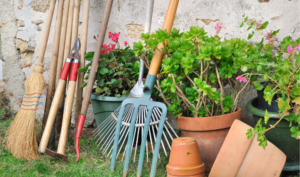
Looking to fill up your garden shed but not sure where to start? We’ve compiled a list of five essential tools you’ll need for your

This is how to calculate the area of your garden bed.
Calculating Area for Landscapes and Gardens
If you are planning on establishing a new garden or renovating an existing garden, you’ll need to know how to calculate the area of garden supplies such as lawn, pavers, mulch, soil, concrete and more. Knowing the area you wish to cover will help the team at Newtons Building and Landscape Supplies calculate the correct quantity or volume of the landscape supplies you need to order.
You may be familiar with calculating the area of a square but what about those more difficult shapes like triangles or circles? The team at Newtons Building and Landscape Supplies have put together this guide to help you calculate the area for various shapes commonly found in your gardens and landscaping.
The most common unit for an area is meter squared or m2. Don’t forget to convert any measurements for a shape to meters before calculating the area.
Squares and Rectangles
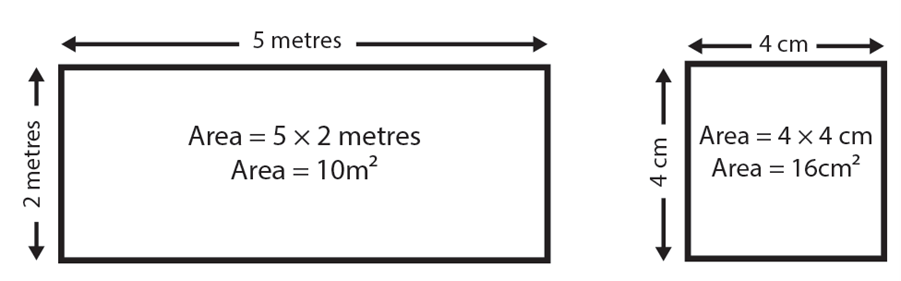
The simplest and most common shapes that you will encounter are squares and rectangles.
To find the area of a rectangle multiply its length by its width. (Rectangle Area = L x W)
As each side of a square is equal, you will only need to find the length of one side then multiply this by itself to find the area. (Square Area = L x L)
It is good practice to check that a shape doesn’t just appear to be but is actually a square or rectangle. Measure two sides for squares. Measure both lengths and both widths for rectangles.
Often, shapes found in garden landscapes can be more complex. In these cases, the trick is to split the shape into several rectangles (or squares). It doesn’t matter how you split the shape. As you can see, any of the three solutions featured below will result in the same answer.
Solution 1 and 2 require that you make two shapes and add their areas together to find the total area.
For solution 3 you make a larger shape (A) and subtract the smaller shape (B) from it to find the area.
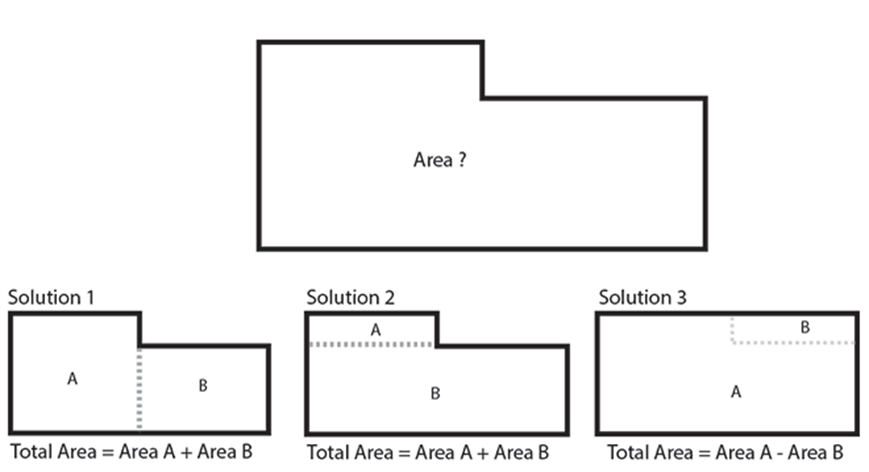
Often, shapes found in garden landscapes can be more complex. In these cases, the trick is to split the shape into several rectangles (or squares). It doesn’t matter how you split the shape. As you can see, any of the three solutions featured below will result in the same answer.
Solution 1 and 2 require that you make two shapes and add their areas together to find the total area.
For solution 3 you make a larger shape (A) and subtract the smaller shape (B) from it to find the area.
Triangles
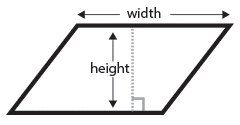
Thinking of a triangle as half of a square or parallelogram can make it easier to work out the area.
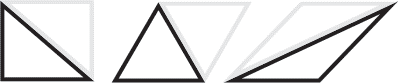
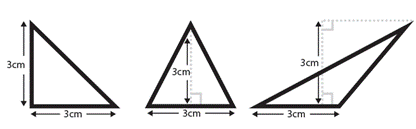
You can work out the area of a triangle by multiplying its height by its width and then dividing by 2. i.e, half of a square, rectangle or parallelogram. (Rectangle Area = H x W ÷ 2)
That means you can work out the area of a triangle in the same way as a square, rectangle or parallelogram, then just divide your answer by 2.
The height of a triangle is found by measuring as a right-angled line from the bottom line to the top point of the triangle.
Circles
In order to calculate the area of a circle you need to know its diameter or radius. The diameter of a circle is the length of a straight line from one side of the circle to the other that passes through the central point of the circle. The diameter is twice the length of the radius (diameter = radius × 2). The radius of a circle is the length of a straight line from the central point of the circle to its edge. The radius is half of the diameter. (radius = diameter ÷ 2).
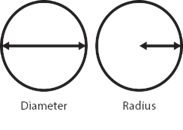
As long as it passes through or commences at the centre point, you can measure the diameter or radius at any point around the circle. However, most times, it’s easier to measure the diameter, then divide by 2 to find the radius. You will need the radius to work out the area of a circle.
(Circle Area = πR2)
π = value of 3.142
R = radius of the circle.
R2 (radius squared) = radius × radius.
Therefore, the area of a circle with a 5m radius can be calculated as follows;
3.142 × 5 × 5 = 78.55cm2.
A circle with a 3m diameter can be calculated as follows;
Radius = Diameter ÷ 2
Radius = (3m ÷ 2 = 1.5m)
Then apply the πR2 formula. 3.142 × 1.5 × 1.5 = 7.0695m2.
As mentioned in our “Squares and Rectangles” section, shapes found in garden landscapes can be more complex. In these cases, the trick is to split the shape into individual shapes and add your answers together for total area or m2. You may find it useful to draw the entire shape on a piece of paper, then draw lines to break it up into smaller, individual shapes for easy area calculations. After you have worked out the smaller shapes’ areas, simply add all your answers together for a final area.
Depending on which product you require, for example lawn, you may want to order a couple extra m2 to allow for cut offs. If you are unsure as to how much extra landscape or building supplies you might need to complete your project, simply ask the team at Newtons Building and Landscape Supplies. We’re always happy to help.

Looking to fill up your garden shed but not sure where to start? We’ve compiled a list of five essential tools you’ll need for your